Homework for 31 Jan 2012 - Explanation of BrainPop

While a screen (scene by scene) explanation is not possible, I can only describe the following as a series of events that lead to an eventual goal. 
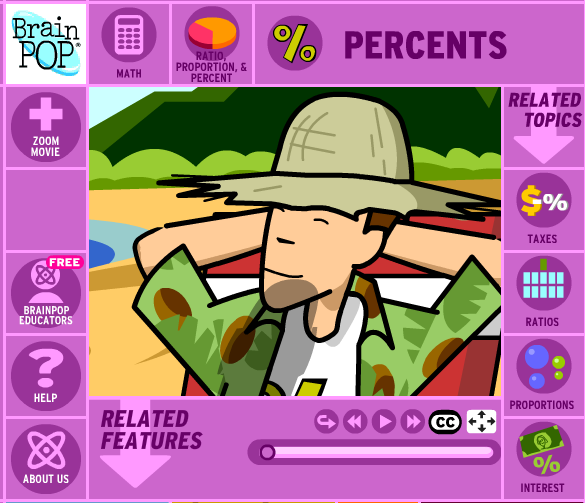
Instructional Goals
  • This BrainPop video describes three ways to calculate percents
  • This event illustrates the concept that percents are based on a ratio relationship out of 100.
  • It further illustrates the concept of proportion in relation to percents as a way solve algebraic equations.
  • It also illustrates how to apply percents to situations via direct variation.
  • The final instruction is to demonstrate part vs. whole relationships as decimals and percents

 Animation Description

  • Beach scene animation, Moby walks up to Tim creating shadows
  • Secondary shot to Vacation Schedule
  • Frame change to shadow again
  • Back to secondary shot involving question
  • Quick shot to Tim and Moby about question
  • Split screen shot with Tim and mathematical explanation of percents
  • Split screen explains part vs whole components about daily routine
  • Daily fishing agenda provides info for setting up proportions
  • Next animation provides multiplication properties of percents
  • Final animation illustrates converting a portion of the day to a percent and applying it to the total time
  • Final animation shows a summation of free time


eLearning

and the Science of

                             Instruction


Ruth Colvin Clark and Richard E. Mayer


 Key Points

  • Conversation vs Formal language presents challenges
  • Independent training presents challenges, formal lingo my not be the best course of action
  • Conventional wisdom conveys information needs to presented in a logical and formal format, but yet people perform better in non-conventional situations.
  • Real-life scenarios seem a more appropriate fit, and the addition of a personal trainer (agent) facilitates ease of concept development and personal interactions with software.
  • Positive responses come from Agents who appear to have real voices over robotic computer simulated voices

Special Education Viewpoints

  • Some special education students benefit from voice activated software for reading and writing.  Those programs that involve robotic voices create distress and disconnect with programs that are created to help.
  • Special education students do not want to appear different from regular education students, and consequently any program that illustrates their fears is not productive.
  • Books on tape are common, but only effective when read by an individual rather than a computer program.  Unfortunately, most services are only available for students that qualify for visual impairments, at the detriment to students who do not normally qualify.

 Homework for 7 February 2012

  • Some initial ideas for my final project would be to create a short video introduction to factoring using South Park characters.  I chose South Park because of its similarity to BrainPop movies.  Hopefully, the characters will not be too hard to reproduce.
  • Most of the focus will be on factoring on the blackboard.  If I can complete some initial story boards with efficiency, then I can look into creating more animation with the characters. 
  • The Instructional Design would also include additions to my school website for students to follow up with outside the normal class time.
  • At the high school level, South Park is still popular and would serve as an entertaining Agent to focus attention.
 

 Learning with Media

Robert B. Kozma

University of Michigan

  • Even though this was written some twenty years ago, this article supports the need for specialized instruction with students who have difficulty keeping up with the pace and delivery of instruction. 
  • Clearly one model will not work for all students, but with today's high input and multimodal media, special consideradtion should be given to the delivery of content for all students.
  • Kozma had the foresight long ago about the benefits of learning with computers, and it would be interesting to how both him and Clark would respond to learning with Media today.

This free website was made using Yola.

No HTML skills required. Build your website in minutes.

Go to www.yola.com and sign up today!

Make a free website with Yola